Our philosophy

Why we exist.

Brocklehurst Academy exists to help students in Years 7 to 12 become genuinely good readers, writers and thinkers in English, and to do well in their school assessments and the HSC because of it, not instead of it.

We work with students one-on-one and in small groups, in person around Burwood and online. Whatever the format, the aim is the same: a student who leaves us able to do more on their own than when they arrived.

What we believe about English

English is a thinking subject.

English is not a memory subject. It is a thinking subject that happens to be assessed in writing.

The students who do best are not the ones who have collected the most quotes or the most polished pre-written paragraphs. They are the ones who have read their texts closely, have something real to say about them, and can say it clearly under pressure.

We believe:

  1. 01

    Every student can improve.

    Some arrive struggling with sentence control; others are chasing a Band 6 or an E4. Both deserve teaching that starts where they actually are.

  2. 02

    Reading comes first.

    Good writing about texts grows out of careful, curious reading. There is no shortcut around the text itself.

  3. 03

    Structure serves ideas.

    Proven structures help students organise their thinking and give markers what they are looking for, so we teach them deliberately: PETAL with our younger students, and IQTVEVE with our older students. But a structure is there to carry an argument, not to stand in for one. Students should be filling it with their own ideas, not with a memorised script.

  4. 04

    Writing is a craft that can be taught.

    Clarity, precision, sentence variety and a confident voice are learnable skills, not talents some students simply have.

  5. 05

    English is worth enjoying.

    Literature, film, poetry and persuasive writing are not obstacles between a student and an ATAR. We want students to find something in their texts that they actually care about, because that is also where their best writing comes from.

What good teaching looks like

How we teach.

Close reading

We teach students to slow down and look: at word choice, imagery, structure, form, perspective and context. A good lesson often spends more time on one paragraph or one stanza than students expect. The goal is for students to notice things for themselves, so we ask more questions than we answer.

Writing craft

We teach writing explicitly, at the level of the sentence, the paragraph and the whole response. That includes analytical essays, creative writing, discursive and persuasive pieces, and reflections. We model, we write alongside students, and we have them rewrite. Strong writing is usually rewritten writing.

Original ideas, not generic answers

We want students to develop their own interpretations and defend them with evidence. We push past generic thesis statements (“the composer explores the human experience”) towards specific, arguable claims about how and why a text works. A slightly rough but original idea is worth more than a smooth but empty one.

Feedback that changes something

Feedback is only useful if the student can act on it. We aim to give a small number of clear, specific priorities rather than a page of corrections, and we check whether the next piece of writing shows the change.

Grounded in the NSW syllabus

Our teaching is guided by the NSW English syllabus, the HSC modules and the way school assessment tasks are actually set and marked. In the junior years, that means building the reading, writing and analytical foundations that senior English depends on. In Years 11 and 12, across English Standard, Advanced, Extension 1 and Extension 2, it means teaching students what each module is really asking, using the rubrics and marking guidelines as tools rather than mysteries.

Two ways we teach

Different stages, different needs.

Students need different things at different stages, so we teach in two ways.

Years 7–10

In the junior years, a carefully designed course.

Years 7 to 10 are when the foundations are laid, and foundations are best built in a deliberate order. Our approach for these years is a set course, taught in small classes, that moves step by step: from the building blocks of grammar and expression, learnt through real texts rather than drills, up to the kind of analysis students will meet in Stage 6. Each lesson is carefully prepared with clear goals, and tasks can be offered with or without scaffolds so every student is stretched at the right level. The aim is that by the time students reach Year 11, the skills are already there.

Deep skills and top bands

Deep skills. Top bands.

We want our students to get the very best bands they can, and we won’t pretend otherwise. Marks matter to students and families. Developing real reading, thinking and writing skill is hugely important to us, but we also know students need the best marks they can get. So we balance the two. When a task calls for it, we play to its expectations and make sure students hit the criteria they are being marked against.

There are concrete things students must do to reach the top bands, and we teach them explicitly:

  • the IQTVEVE structure for older students (younger students build up to it with PETAL)
  • ATQing: answering the question throughout a response, not just in the introduction
  • a bank of precise analytical verbs
  • paragraph structure that weaves context in rather than tacking it on
  • concise theses and topic sentences
  • regular practice in timed conditions

These techniques sit on top of genuine skill rather than replacing it. A well-built paragraph only shines when there is a real idea inside it, and an insightful reading only earns its marks when it is expressed the way markers are looking for. Students need both, and we teach both. Learning how to build a strong response is very different from learning one off by heart, which is why we teach structures and techniques but not memorised essays.

What genuinely helping a student means

Help that makes students independent.

Independence over dependence

The best measure of our work is how little a student needs us by the end of Year 12. We want students to leave able to read an unseen text, plan a response and edit their own writing. A student who can only write well with a tutor beside them has not yet been helped enough.

Building confidence honestly

Many students arrive believing they are “bad at English”. Confidence comes from real, visible progress, so we make that progress visible: comparing earlier and later drafts, naming specifically what has improved, and setting achievable next steps. We praise effort and improvement truthfully, and we do not flatter.

We do not do the work for students

We will never write a student’s assessment, essay or creative piece for them, and we will not “polish” submitted work to the point where it is no longer theirs. We help students plan, we give feedback on drafts, and we teach the skills they need to fix their own writing. This is a matter of integrity and of school rules, but it is also simply better teaching: a student who did not write the essay did not learn from it. It is how we work every day: our tutors guide and give feedback, but they never write a student’s essays. The same principle shapes our approach to AI, set out below: students learn to use it intelligently, and some spaces stay AI-free.

Model essays and study guides, used properly

Model essays and study notes have a place. Seeing what a strong response looks like is useful, especially when a student is new to a text type. But a model is something to learn from, not something to copy or memorise. We use models to discuss choices (“why does this paragraph work?”), and then students write their own. Study guides can support understanding of a text; they cannot replace reading it.

Honesty with families

We tell families the truth about where a student is, what is realistic and what it will take. That includes good news, and it includes the harder conversations: when a student is not doing the work between lessons, when a goal is unlikely in the time available, or when tuition is not what a student most needs right now. Parents can only make good decisions with accurate information.

Our position on AI

AI, used well.

AI tools like ChatGPT are here to stay, and they can do remarkable things. We don’t think the answer is to pretend they don’t exist or to ban them outright. We think students need to be taught to use them well, and that is part of our job.

Used intelligently, AI can be a powerful study partner. We actively teach students how to use it to:

  • Test their knowledge, for example by having it quiz them on a text, its context or a module’s key ideas.
  • Build their own study tools, such as simple apps, flashcards or revision quizzes.
  • Explore exemplar writing, generating model responses to pull apart and discuss, in the same spirit as our approach to model essays: to learn from, never to copy.
  • Get feedback on their writing that they then act on themselves.

There is a time and place for AI, though, and we believe there are important spaces where it doesn’t belong:

  • Assessed or submitted work. Anything handed in as a student’s own should be their own.
  • Exams and in-class timed writing. These are where students show what they can do unaided, so we think the practice for them is best done unaided too.
  • Building their own thinking and voice. Forming an interpretation, wrestling with a difficult passage and finding how they want to say something is the work that makes a student a better reader and writer. If AI does that work, the student misses the learning.

At the academy we use Edexia, an AI program that gives feedback on HSC essays and is built on HSC rubrics and texts. It is a good example of AI doing what it should: helping students see where their writing stands and what to work on next, while the writing itself stays theirs.

The line we draw is simple: AI can help a student practise, check and reflect, but it should never do the thinking or the writing for them.
How students should prepare for exams

Preparation starts long before exam week.

Good exam preparation starts long before exam week. What we encourage every student to do:

  1. 1

    Build habits early.

    Regular reading, regular writing and steady revision across the year beat cramming. A little writing every week does more than a lot of writing the week before.

  2. 2

    Know the texts deeply.

    Read prescribed texts more than once. Know them well enough to choose fresh evidence for an unexpected question, rather than relying on a short list of famous quotes.

  3. 3

    Understand the module, not just the text.

    In senior years especially, students need to understand what each module values and how their text speaks to it.

  4. 4

    Practise under timed conditions.

    Writing well in 40 minutes is its own skill. We build up timed practice gradually as exams approach, using past and practice questions.

  5. 5

    Draft and redraft.

    Before exams, students should write, get feedback, rewrite and then write again on a new question. Improvement happens in the redraft.

  6. 6

    Avoid memorised generic essays.

    Pre-writing a full essay and hoping the question fits is risky and usually shows. Markers reward responses that engage with the actual question. We help students prepare flexible material (strong ideas, well-understood evidence, practised paragraphs) that can be adapted on the day, rather than a script.

  7. 7

    Look after wellbeing.

    Sleep, exercise, time with friends and realistic expectations are part of exam preparation, not distractions from it. We would rather a student arrive at the HSC rested and prepared than exhausted and over-rehearsed. If we notice a student is struggling beyond English, we will raise it gently with the family.

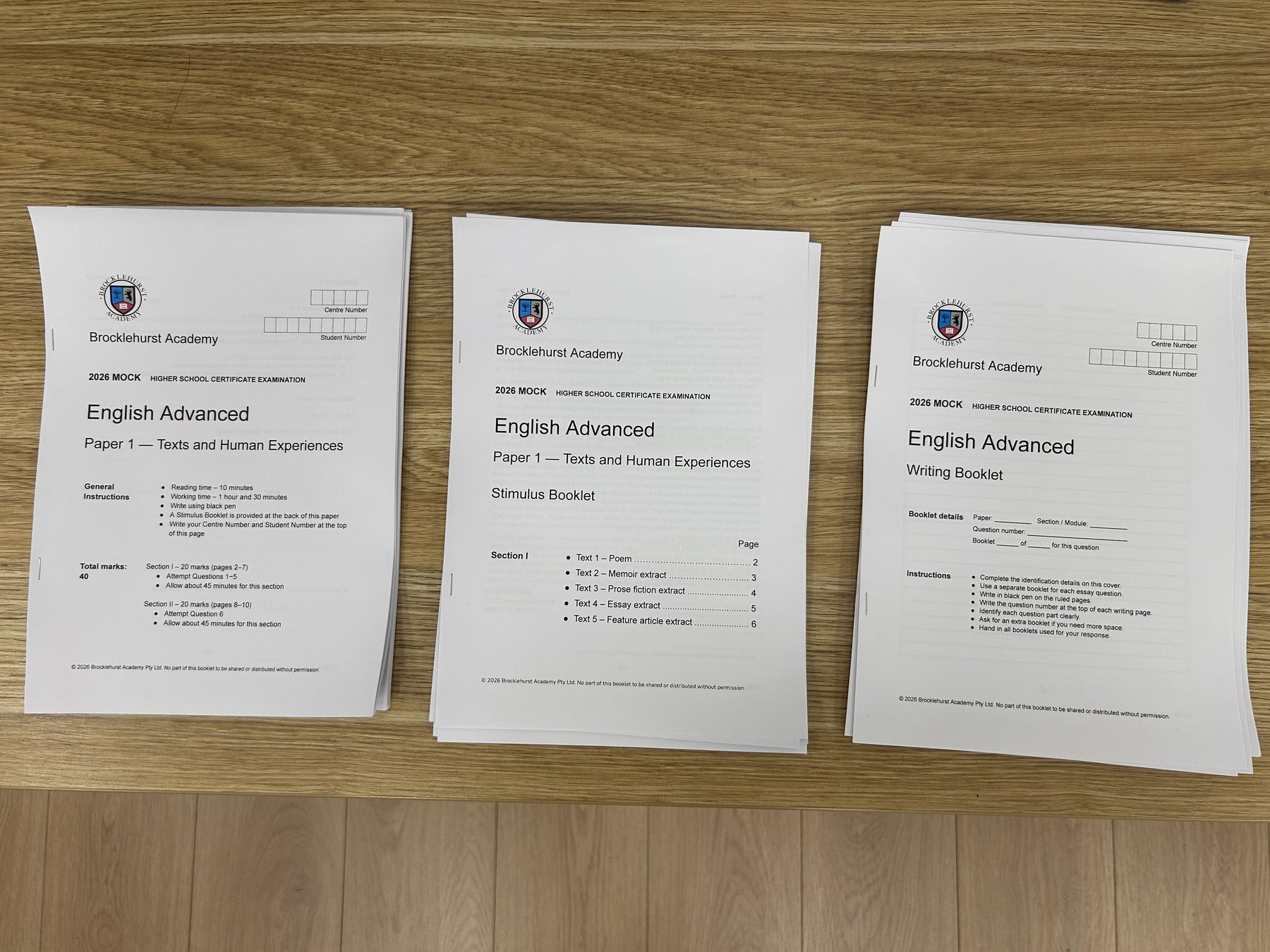
Practice exam papers for English Advanced at Brocklehurst Academy
What families can expect

When your child learns with us.

When your child learns with us, you can expect:

A clear starting point.

We take time to understand your child’s strengths, gaps, school and goals.

Teaching tailored to your child.

In junior classes, that means a carefully sequenced course pitched at the right level; in the senior years and one-on-one, lessons follow your child’s school texts and assessment schedule. Either way, we focus on what will make the biggest difference.

Regular, honest communication.

We will tell you what is going well, what needs work and what you can do to help.

Integrity.

Your child’s work will always be their own.

Communication that works for your family.

Many of our families speak Chinese at home. We want every parent to understand clearly how their child is going, and we will work with each family to find the way of keeping in touch that suits them best.

A partnership.

Tuition works best when students, families and tutors are pulling in the same direction. We will ask for your support with routines at home, and we welcome your questions at any time.

We know many families come to tuition hoping for a particular mark or band. We share that goal, and we take it seriously, which is why we teach the concrete techniques that earn top bands. And we believe the surest way to a strong result is a student who also reads well, writes well and thinks for themselves, and that is what we set out to build.

Begin with a trial lesson.

Group class or private tuition? In-person or online? Tell us about your student and we’ll help you choose.

Book a trial lesson